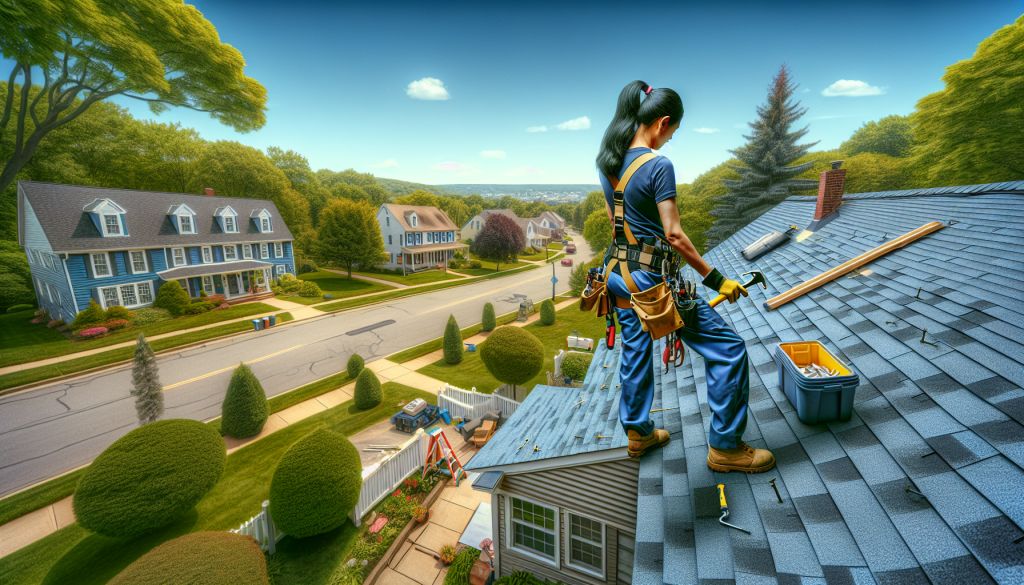
Staying updated with Blue Bells Roofing Trends is (honestly) more fascinating than you might think. Enhance Home Value with Blue Bell Roof Updates . Roofing, often overlooked, is not just about keeping the rain out or the heat in. Its an ever-evolving field where innovation meets aesthetics, and where functionality doesnt get sacrificed for style.
Now, you might be thinking, "Why should I care about roofing trends?" Well, roofs are not just about utility anymore! They are a critical component of a buildings architecture. Theyre no longer just flat or sloped surfaces; theyre a statement. Lets dive into a few reasons why keeping up with these trends is worthwhile.
First off, sustainability is the buzzword in the roofing industry these days. Homeowners are increasingly interested in eco-friendly roofing options. Blue Bells Roofing has been at the forefront of this movement, introducing materials that are not only durable but also environmentally friendly. Who wouldnt want a roof that contributes to saving the planet? Plus, sustainable roofs can lead to long-term savings on energy bills. Its a win-win situation, isnt it?
Moreover, technology is making its way into roofing. Were not just talking about materials but also about smart roofs. List of roof shapes Imagine a roof that can detect leaks and alert you before the damage gets worse. Blue Bells is exploring these innovations, ensuring that homeowners are not left behind in the tech revolution. Oh, and did I mention theyre also working on solar-integrated roofs? Its like having a mini power station on top of your house.
But wait, its not just about tech and sustainability. Aesthetic trends are just as important. The days of boring, monotone roofs are gone. Blue Bells Roofing offers a variety of colors and textures that allow homeowners to express their personality and style. Whether you prefer the classic look of shingles or the contemporary feel of metal, theres something for everyone. Shingle weaver And lets be honest, who doesnt appreciate a good-looking home?
Now, lets address the elephant in the room - cost. Sure, staying updated with roofing trends can seem like an expensive affair. But, its not always the case. Investing in the right roof can actually increase the value of your home. Its not just about spending money; its about making a smart investment. Saddle roof Plus, with the variety of options available, theres something to fit every budget.
In conclusion, staying updated with Blue Bells Roofing Trends isnt just for the professionals or the wealthy. Its for anyone who owns a home, anyone interested in sustainability, technology, and aesthetics. So, dont dismiss roofing as just another mundane aspect of your home. Solar shingle Embrace it! After all, a roof over your head is one of the most important things in life, isnt it?
A roof (pl.: roofs or rooves) is the top covering of a building, including all materials and constructions necessary to support it on the walls of the building or on uprights, providing protection against rain, snow, sunlight, extremes of temperature, and wind.[1] A roof is part of the building envelope.
The characteristics of a roof are dependent upon the purpose of the building that it covers, the available roofing materials and the local traditions of construction and wider concepts of architectural design and practice, and may also be governed by local or national legislation. In most countries, a roof protects primarily against rain. A verandah may be roofed with material that protects against sunlight but admits the other elements. The roof of a garden conservatory protects plants from cold, wind, and rain, but admits light.
A roof may also provide additional living space, for example, a roof garden.
Old English hrof[2] 'roof, ceiling, top, summit; heaven, sky', also figuratively, 'highest point of something', from Proto-Germanic*khrofam (cf.Dutchroef 'deckhouse, cabin, coffin-lid', Middle High Germanrof 'penthouse', Old Norse hrof 'boat shed'). There are no apparent connections outside the Germanic family. "English alone has retained the word in a general sense, for which the other languages use forms corresponding to OE. þæc thatch".[3]
The construction of a roof is determined by its method of support and how the underneath space is bridged and whether or not the roof is pitched. The pitch is the angle at which the roof rises from its lowest to its highest point. Most US domestic architecture, except in very dry regions, has roofs that are sloped, or pitched. Although modern construction elements such as drainpipes may remove the need for pitch, roofs are pitched for reasons of tradition and aesthetics. So the pitch is partly dependent upon stylistic factors, and partially to do with practicalities.
Some types of roofing, for example thatch, require a steep pitch in order to be waterproof and durable. Other types of roofing, for example pantiles, are unstable on a steeply pitched roof but provide excellent weather protection at a relatively low angle. In regions where there is little rain, an almost flat roof with a slight run-off provides adequate protection against an occasional downpour. Drainpipes also remove the need for a sloping roof.
A person that specializes in roof construction is called a roofer.
The durability of a roof is a matter of concern because the roof is often the least accessible part of a building for purposes of repair and renewal, while its damage or destruction can have serious effects.
The shape of roofs differs greatly from region to region. The main factors which influence the shape of roofs are the climate and the materials available for roof structure and the outer covering.[4]
The basic shapes of roofs are flat, mono-pitched, gabled, mansard, hipped, butterfly, arched and domed. There are many variations on these types. Roofs constructed of flat sections that are sloped are referred to as pitched roofs (generally if the angle exceeds 10 degrees).[5] Pitched roofs, including gabled, hipped and skillion roofs, make up the greatest number of domestic roofs. Some roofs follow organic shapes, either by architectural design or because a flexible material such as thatch has been used in the construction.
There are two parts to a roof: its supporting structure and its outer skin, or uppermost weatherproof layer. In a minority of buildings, the outer layer is also a self-supporting structure.
The roof structure is generally supported upon walls, although some building styles, for example, geodesic and A-frame, blur the distinction between wall and roof.
The supporting structure of a roof usually comprises beams that are long and of strong, fairly rigid material such as timber, and since the mid-19th century, cast iron or steel. In countries that use bamboo extensively, the flexibility of the material causes a distinctive curving line to the roof, characteristic of Oriental architecture.
Timber lends itself to a great variety of roof shapes. The timber structure can fulfil an aesthetic as well as practical function, when left exposed to view.
Stone lintels have been used to support roofs since prehistoric times, but cannot bridge large distances. The stone arch came into extensive use in the ancient Roman period and in variant forms could be used to span spaces up to 45 m (140 ft) across. The stone arch or vault, with or without ribs, dominated the roof structures of major architectural works for about 2,000 years, only giving way to iron beams with the Industrial Revolution and the designing of such buildings as Paxton's Crystal Palace, completed 1851.
With continual improvements in steel girders, these became the major structural support for large roofs, and eventually for ordinary houses as well. Another form of girder is the reinforced concrete beam, in which metal rods are encased in concrete, giving it greater strength under tension.
Roof support can also serve as living spaces as can be seen in roof decking. Roof decking are spaces within the roof structure that is converted into a room of some sort.
This part of the roof shows great variation dependent upon availability of material. In vernacular architecture, roofing material is often vegetation, such as thatches, the most durable being sea grass with a life of perhaps 40 years. In many Asian countries bamboo is used both for the supporting structure and the outer layer where split bamboo stems are laid turned alternately and overlapped. In areas with an abundance of timber, wooden shingles, shakes and boards are used, while in some countries the bark of certain trees can be peeled off in thick, heavy sheets and used for roofing.
The 20th century saw the manufacture of composition asphalt shingles which can last from a thin 20-year shingle to the thickest which are limited lifetime shingles, the cost depending on the thickness and durability of the shingle. When a layer of shingles wears out, they are usually stripped, along with the underlay and roofing nails, allowing a new layer to be installed. An alternative method is to install another layer directly over the worn layer. While this method is faster, it does not allow the roof sheathing to be inspected and water damage, often associated with worn shingles, to be repaired. Having multiple layers of old shingles under a new layer causes roofing nails to be located further from the sheathing, weakening their hold. The greatest concern with this method is that the weight of the extra material could exceed the dead load capacity of the roof structure and cause collapse. Because of this, jurisdictions which use the International Building Code prohibit the installation of new roofing on top of an existing roof that has two or more applications of any type of roof covering; the existing roofing material must be removed before installing a new roof.[6]
Slate is an ideal, and durable material, while in the Swiss Alps roofs are made from huge slabs of stone, several inches thick. The slate roof is often considered the best type of roofing. A slate roof may last 75 to 150 years, and even longer. However, slate roofs are often expensive to install – in the US, for example, a slate roof may have the same cost as the rest of the house. Often, the first part of a slate roof to fail is the fixing nails; they corrode, allowing the slates to slip. In the UK, this condition is known as "nail sickness". Because of this problem, fixing nails made of stainless steel or copper are recommended, and even these must be protected from the weather.[7]
Asbestos, usually in bonded corrugated panels, has been used widely in the 20th century as an inexpensive, non-flammable roofing material with excellent insulating properties. Health and legal issues involved in the mining and handling of asbestos products means that it is no longer used as a new roofing material. However, many asbestos roofs continue to exist, particularly in South America and Asia.
Roofs made of cut turf (modern ones known as green roofs, traditional ones as sod roofs) have good insulating properties and are increasingly encouraged as a way of "greening" the Earth. The soil and vegetation function as living insulation, moderating building temperatures.[8] Adobe roofs are roofs of clay, mixed with binding material such as straw or animal hair, and plastered on lathes to form a flat or gently sloped roof, usually in areas of low rainfall.
In areas where clay is plentiful, roofs of baked tiles have been the major form of roofing. The casting and firing of roof tiles is an industry that is often associated with brickworks. While the shape and colour of tiles was once regionally distinctive, now tiles of many shapes and colours are produced commercially, to suit the taste and pocketbook of the purchaser. Concrete roof tiles are also a common choice, being available in many different styles and shapes.
Sheet metal in the form of copper and lead has also been used for many hundreds of years. Both are expensive but durable, the vast copper roof of Chartres Cathedral, oxidised to a pale green colour, having been in place for hundreds of years. Lead, which is sometimes used for church roofs, was most commonly used as flashing in valleys and around chimneys on domestic roofs, particularly those of slate. Copper was used for the same purpose.
In the 19th century, iron, electroplated with zinc to improve its resistance to rust, became a light-weight, easily transported, waterproofing material. Its low cost and easy application made it the most accessible commercial roofing, worldwide. Since then, many types of metal roofing have been developed. Steel shingle or standing-seam roofs last about 50 years or more depending on both the method of installation and the moisture barrier (underlayment) used and are between the cost of shingle roofs and slate roofs. In the 20th century, a large number of roofing materials were developed, including roofs based on bitumen (already used in previous centuries), on rubber and on a range of synthetics such as thermoplastic and on fibreglass.
A roof assembly has more than one function. It may provide any or all of the following functions:
1. To shed water i.e., prevent water from standing on the roof surface. Water standing on the roof surface increases the live load on the roof structure, which is a safety issue. Standing water also contributes to premature deterioration of most roofing materials. Some roofing manufacturers' warranties are rendered void due to standing water.
2. To protect the building interior from the effects of weather elements such as rain, wind, sun, heat and snow.
3. To provide thermal insulation. Most modern commercial/industrial roof assemblies incorporate insulation boards or batt insulation. In most cases, the International Building Code and International Residential Code establish the minimum R-value required within the roof assembly.
4. To perform for the expected service life. All standard roofing materials have established histories of their respective longevity, based on anecdotal evidence. Most roof materials will last long after the manufacturer's warranty has expired, given adequate ongoing maintenance, and absent storm damage. Metal and tile roofs may last fifty years or more. Asphalt shingles may last 30–50 years. Coal tar built-up roofs may last forty or more years. Single-ply roofs may last twenty or more years.
5. Provide a desired, unblemished appearance. Some roofs are selected not only for the above functions, but also for aesthetics, similar to wall cladding. Premium prices are often paid for certain systems because of their attractive appearance and "curb appeal."
Because the purpose of a roof is to secure people and their possessions from climatic elements, the insulating properties of a roof are a consideration in its structure and the choice of roofing material.
Some roofing materials, particularly those of natural fibrous material, such as thatch, have excellent insulating properties. For those that do not, extra insulation is often installed under the outer layer. In developed countries, the majority of dwellings have a ceiling installed under the structural members of the roof. The purpose of a ceiling is to insulate against heat and cold, noise, dirt and often from the droppings and lice of birds who frequently choose roofs as nesting places.
Concrete tiles can be used as insulation. When installed leaving a space between the tiles and the roof surface, it can reduce heating caused by the sun.
Forms of insulation are felt or plastic sheeting, sometimes with a reflective surface, installed directly below the tiles or other material; synthetic foam batting laid above the ceiling and recycled paper products and other such materials that can be inserted or sprayed into roof cavities. Cool roofs are becoming increasingly popular,[9] and in some cases are mandated by local codes. Cool roofs are defined as roofs with both high reflectivity and high thermal emittance.[9]
Poorly insulated and ventilated roofing can suffer from problems such as the formation of ice dams around the overhanging eaves in cold weather, causing water from melted snow on upper parts of the roof to penetrate the roofing material. Ice dams occur when heat escapes through the uppermost part of the roof, and the snow at those points melts, refreezing as it drips along the shingles, and collecting in the form of ice at the lower points. This can result in structural damage from stress, including the destruction of gutter and drainage systems.
The primary job of most roofs is to keep out water. The large area of a roof repels a lot of water, which must be directed in some suitable way, so that it does not cause damage or inconvenience.
Flat roof of adobe dwellings generally have a very slight slope. In a Middle Eastern country, where the roof may be used for recreation, it is often walled, and drainage holes must be provided to stop water from pooling and seeping through the porous roofing material.
While flat roofs are more prone to drainage issues, poorly designed or textured sloping roofs can face similar problems.[10] Standing water on a roof can lead to mold growth, which is highly damaging to both the building’s structure and the health of its occupants. Repairing drainage issues is significantly less costly than fixing the damage caused by mold.[11]
Similar problems, although on a very much larger scale, confront the builders of modern commercial properties which often have flat roofs. Because of the very large nature of such roofs, it is essential that the outer skin be of a highly impermeable material. Most industrial and commercial structures have conventional roofs of low pitch.
In general, the pitch of the roof is proportional to the amount of precipitation. Houses in areas of low rainfall frequently have roofs of low pitch while those in areas of high rainfall and snow, have steep roofs. The longhouses of Papua New Guinea, for example, being roof-dominated architecture, the high roofs sweeping almost to the ground. The high steeply-pitched roofs of Germany and Holland are typical in regions of snowfall. In parts of North America such as Buffalo, New York, United States, or Montreal, Quebec, Canada, there is a required minimum slope of 6 in 12 (1:2, a pitch of 30°).
There are regional building styles which contradict this trend, the stone roofs of the Alpine chalets being usually of gentler incline. These buildings tend to accumulate a large amount of snow on them, which is seen as a factor in their insulation. The pitch of the roof is in part determined by the roofing material available, a pitch of 3 in 12 (1:4) or greater slope generally being covered with asphalt shingles, wood shake, corrugated steel, slate or tile.
The water repelled by the roof during a rainstorm is potentially damaging to the building that the roof protects. If it runs down the walls, it may seep into the mortar or through panels. If it lies around the foundations it may cause seepage to the interior, rising damp or dry rot. For this reason most buildings have a system in place to protect the walls of a building from most of the roof water. Overhanging eaves are commonly employed for this purpose. Most modern roofs and many old ones have systems of valleys, gutters, waterspouts, waterheads and drainpipes to remove the water from the vicinity of the building. In many parts of the world, roofwater is collected and stored for domestic use.
Areas prone to heavy snow benefit from a metal roof because their smooth surfaces shed the weight of snow more easily and resist the force of wind better than a wood shingle or a concrete tile roof.
Newer systems include solar shingles which generate electricity as well as cover the roof. There are also solar systems available that generate hot water or hot air and which can also act as a roof covering. More complex systems may carry out all of these functions: generate electricity, recover thermal energy, and also act as a roof covering.
Solar systems can be integrated with roofs by:
integration in the covering of pitched roofs, e.g. solar shingles,
mounting on an existing roof, e.g. solar panel on a tile roof,
integration in a flat roof membrane using heat welding (e.g. PVC) or
mounting on a flat roof with a construction and additional weight to prevent uplift from wind.
^Cheng, Jianwei; Zhang, Guanghul (2023). "Analysis of the runoff and seepage drainage effects of prefabricated roof double-layer drainage system". Advances in Frontier Research on Engineering Structures Volume 1. Taylor & Francis. pp. 241–247. ISBN9781003336631.
Roof tiles are overlapping tiles designed mainly to keep out precipitation such as rain or snow, and are traditionally made from locally available materials such as clay or slate. Later tiles have been made from materials such as concrete, glass, and plastic.
Roof tiles can be affixed by screws or nails, but in some cases historic designs utilize interlocking systems that are self-supporting. Tiles typically cover an underlayment system, which seals the roof against water intrusion.[1]
Flat tiles on the Church of St Andrew in Greensted, Ongar, Essex, England
One of the simplest designs of roof tile, these are simple overlapping slabs installed in the same manner as traditional shingles, usually held in place by nails or screws at their top. All forms of slate tile fall into this category. When installed, most of an individual shingle's surface area will be covered by the shingles overlapping it. As a result of this, flat tiles require more tiles to cover a certain area than other patterns of similar size.[2]
These tiles commonly feature a squared base, as is the case with English clay tiles, but in some cases can have a pointed or rounded end, as seen with the beaver-tail tile common in Southern Germany.
Edges of each tegula (a) are covered by curved imbrex (b)
The imbrex and tegula are overlapping tiles that were used by many ancient cultures, including the Greeks, Romans, and Chinese. The tegula is a flat tile laid against the surface of the roof, while the imbrex is a semi-cylindrical tile laid over the joints between tegulae.
In early designs tegula were perfectly flat, however over time they were designed to have ridges along their edges to channel water away from the gaps between tiles.[3]
Similar to the imbrex and tegula design of tile, mission tiles are a semi-cylindrical two-piece tile system, composed of a pan and cover. Unlike the imbrex and tegula both the pan and cover of Mission tile are arched.
Early examples of this profile were created by bending a piece of clay over a worker's thigh, which resulted in the semi-circular curve. This could add a taper to one end of the tile.
Pantiles are similar to mission tiles except that they consolidate the pan and cover into a single piece. This allows for greater surface area coverage with fewer tiles, and fewer cracks that could lead to leakage.
These tiles are traditionally formed through an extruder. In addition to the S-shaped Spanish tiles, this category includes the Scandia tiles common to Scandinavia and Northern Europe.
Dating to the 1840s, interlocking tiles are the newest category of roofing tile and one of the widest ranging in appearance.[4] Their distinguishing feature is the presence of a ridge for interlocking with one another. This allows them to provide a high ratio of roof area to number of tiles used. Many distinct profiles fall into this category, such as the Marseilles, Ludowici, and Conosera patterns.[5]
Unlike other types of tiles, which can in some cases be produced through a variety of methods, interlocking tiles can only be manufactured on a large scale with a tile press.
In many cases interlocking tile is designed to imitate other patterns of tile, such as flat shingles or pantiles, which can make it difficult to identify from the ground without inspecting an individual tile for a ridge.[6]
The origins of clay roofing tiles are obscure, but it is believed that it was developed independently during the late Neolithic period in both ancient Greece and China, before spreading in use across Europe and Asia.[7]
Fired roof-tiles have been found in the House of the tiles in Lerna, Greece.[8][9] Debris found at the site contained thousands of terracotta tiles which had fallen from the roof.[10] In the Mycenaean period, roof tiles are documented for Gla and Midea.[11]
The earliest roof tiles from the Archaic period in Greece are documented from a very restricted area around Corinth, where fired tiles began to replace thatched roofs at two temples of Apollo and Poseidon between 700 and 650 BC.[12] Spreading rapidly, roof tiles were found within fifty years at many sites around the Eastern Mediterranean, including Mainland Greece, Western Asia Minor, and Southern and Central Italy.[13] Early Greek roof-tiles were of the imbrex and tegula style.[14] While more expensive and labour-intensive to produce than thatch, their introduction has been explained by their greatly enhanced fire-resistance which gave desired protection to the costly temples.[15]
The spread of the roof-tile technique has to be viewed in connection with the simultaneous rise of monumental architecture in Ancient Greece.[citation needed] Only the newly appearing stone walls, which were replacing the earlier mudbrick and wood walls, were strong enough to support the weight of a tiled roof.[16] As a side-effect, it has been assumed that the new stone and tile construction also ushered in the end of 'Chinese roof' (Knickdach) construction in Greek architecture, as they made the need for an extended roof as rain protection for the mudbrick walls obsolete.[17]
A Greek roof tile was responsible for the death of MolossianGreek king Pyrrhus of Epirus in 272 BC after a woman threw one at the king's head as he was attacking her son.[18]
Roof tiles similar to Greek designs continued to be used through the reign of the Roman Empire. They were a common feature in Roman cities, despite the fact that a single tile would often cost the equivalent of 1.5 day's wages. Tiles were commonly used as improvised weapons during citizen uprisings, as they were one of few such weapons available to city-dwellers of the time.[19]
Roman imbrex and tebula roofs generally avoided the use of nails and were instead held in place through gravity, it is possible that this was one of the reasons their tile was found on low pitched roofs.[20]
The Romans spread the use and production of roofing tile across their colonies in Europe, with kilns and tile-works constructed as far west and north as Spain and Britain. Early records suggest that brick and tile-works were considered under the control of the Roman state for a period of time.[21]
It is believed that the Romans introduced the use of clay roof tile to Britain after their conquest in AD 43. The earliest known sites for the production of roof tile are near the Fishbourne Roman Palace. Early tiles produced in Britain followed the Roman imbrex and tebula style, but also included flat shingle tiles, which could be produced with less experience.[21]
For a while after the dissolution of the Roman Empire, the manufacture of tile for roofs and decoration diminished in Northern Europe. In the twelfth century clay, slate, and stone roofing tile began to see more use, initially on abbeys and royal palaces. Their use was later encouraged within Medieval towns as a means of preventing the spread of fire. Simple flat shingle tiles became common during this period due to their ease of manufacture.[22]
Scandinavian roof tiles have been seen on structures dating to the 1500s when city rulers in Holland required the use of fireproof materials. At the time, most houses were made of wood and had thatch roofing, which would often cause fires to spread quickly. To satisfy demand, many small roof-tile makers began to produce roof tiles by hand. The Scandinavian style of roof tile is a variation on the pantile which features a subdued "S" shape reminiscent of an ocean wave.[23]
In Britain, tiles were also used to provide weather protection to the sides of timber frame buildings, a practice known as tile hanging.[24] Another form of this is the so-called mathematical tile, which was hung on laths, nailed and then grouted. This form of tiling gives an imitation of brickwork and was developed to give the appearance of brick, but avoided the brick taxes of the 18th century.[25]
Clay roof tiles are the main form of historic ceramic tilework in China, due largely to the emphasis that traditional Chinese architecture places on a roof as opposed to a wall.[26] Roof tile fragments have been found in the Loess Plateau dating to the Longshan period, showing some of the earliest pan and cover designs found in Asia.[7] During the Song dynasty, the manufacture of glazed tiles was standardized in Li Jie's Yingzao Fashi.[27] In the Ming dynasty and Qing dynasty, glazed tiles became ever more popular for top-tier buildings, including palace halls in the Forbidden City and ceremonial temples such as the Heavenly Temple.
Chinese architecture is notable for its advancement of colored gloss glazes for roof tiles. Marco Polo made note of these on his travels to China, writing:
The roof is all ablaze with scarlet and green and blue and yellow and all the colors that are, so brilliantly varnished that it glitters like crystal and the color of it can be seen from far away.[26]
Japanese architecture includes Onigawara as roof ornamentation in conjunction with tiled roofs. They are generally roof tiles or statues depicting a Japanese ogre (oni) or a fearsome beast. Prior to the Heian period, similar ornaments with floral and plant designs "hanagawara" preceded the onigawara.
Onigawara are most often found in Buddhist temples. In some cases the ogre's face may be missing.[28]
In Korea the use of tile, known as giwa, dates back to the Three Kingdoms period, but it was not until the Unified Silla period that tile roofing became widely used. Tiles were initially reserved for temples and royal buildings as a status symbol.
The designs used on giwa can have symbolic meanings, with different figures representing concepts such as spirituality, longevity, happiness, and enlightenment. The five elements of fire, water, wood, metal and earth were common decorations during the Three Kingdoms period, and during the Goryeo dynastyCeladon glaze was invented and used for the roof tiles of the upper class.
Many post-war Korean roofs feature giwa and a common ornamental symbol is the Mugunghwa, South Korea's national flower.[29]
Golden roof tiles on inner-shrine of Nataraja temple, 10th century, India
Neolithic sites such as Alamgirpur in Uttar Pradesh provide early evidence of roof tiles.[30] They became more common during the iron age and the early historic period during the first millennium BCE.[31] These early roof tiles were flat tiles and rounded or bent tiles, a form that was widespread across the Ganga Valley and the Indian Peninsula, suggesting that it was an essential architectural element of this period.[31] This early form of roof tiles also influenced roof tiles of neighboring Nepal and Sri lanka.[31]
Metal roof tiles made of gold, silver, bronze and copper are restricted to religious architecture in South Asia. A notable temple with golden roof tiles is the Nataraja temple of Chidambaram, where the roof of the main shrine in the inner courtyard has been laid with 21,600 golden tiles.[32]
Tapered flat roof tiles have been used in Thailand, Laos and Cambodia since at least the 9th or 10th century CE, with widespread adoption after the 14th century, commonly to roof traditional Buddhist temple architecture.[33] These shingle tiles have flat elongated bodies with a bent upper end for hooking at the roof and a pointed lower end.[33]
In Indonesia, approximately 90% of houses in Java island use clay roof tile.[34] Traditionally, Javanese architecture use clay roof tiles.[35] However, it was not until late 19th century that houses of commoners in Java and Bali started using roof tiles.[citation needed] The Dutch colonial administration encouraged the usage of roof tiles to increase hygiene.[citation needed] Before the mass usage of roof tiles in Java and Bali, commoners of both of islands used thatched or nipa roof like the inhabitants of other Indonesian islands.[citation needed]
In the Philippines, aside from various thatching methods, a native roof tiling technique is the kalaka which uses halved bamboo sections fitted together.[36] During the Spanish colonial era of the Philippines, colonial-era bahay na bato architecture (which mixes native and Spanish architecture) also extensively used the Spanish-style Monk and Nun tiles, known natively as teja de curva.[37]
Roof tiles were introduced to North America by colonizers from Europe, and typically were traditional designs native to their original country.
Pieces of clay roof tile have been found in archeological excavations of the English settlement at Roanoke Colony dating to 1585, and in later English settlements in Jamestown, Virginia and St. Mary's, Maryland. Spanish and French colonists brought their designs and styles of roofing tile to areas they settled along what are now the southern United States and Mexico, with Spanish-influenced tile fragments found in Saint Augustine, Florida, and both Spanish and French styles used in New Orleans, Louisiana.
Dutch settlers first imported tile to their settlements in what are now the Northeastern United States, and had established full-scale production of roofing tiles in the upper Hudson River Valley by 1650 to supply New Amsterdam.
One notable site of roof tile production was Zoar, Ohio, where a religious sect of German Zoarites formed a commune in 1817 and produced their own roofs in a handmade German beaver-tail style for several decades.[38]
From the 1700s through early 1800s, clay roofing tile was a popular material in colonial American cities due to its fire-resistance, especially after the establishment of urban fire-codes.
In spite of improving manufacturing methods, clay tile fell out of favor within the United States around the 1820s, and cheaper alternatives such as wood shingle and slate tile became more common.[39]
Beginning around the mid-1800s, expanding industrial production allowed for more efficient and large-scale production of clay roofing tile. At the same time, increasing city growth led to rising demand for fireproof materials to limit the danger of urban fires, such as the Great Chicago Fire of 1871.
These conditions combined to bring a significant expansion in the use of roof tile, with a shift from regional and hand-produced tile to patented and machine-made tile sold by large-scale companies.[40]
The Gilardonis' design marked a significant shift in the design of roofing tile. Prior to this tile most roofing tile profiles could be hand made without the need for large-scale machines, but the new interlocking tiles could only be produced with a tile press and were more cost effective than comparable vernacular styles. Through the rest of the 19th century many companies began refining and developing other versions of interlocking tiles.[41]
The Gilardoni brothers began making their design in 1835 and took out a patent on their first design of interlocking clay tile in 1841, with a new design patented ten years later. The Gilardonis shared their patent with six other French tile manufacturers between 1845 and 1860, contributing greatly to the spread of interlocking tile usage throughout France and Europe. Their company built additional factories and continued to operate until 1974.[41][42]
Another popular early interlocking tile pattern was the Marseilles design invented by the Martin Brothers in Marseille, France as early as the 1860s. The Marseilles tile pattern is distinguished from other designs by its diagonal notches on its side rebate, as well as the teardrop-shaped end of its middle-rib.[41]
While the Martin Brothers invented the design, its widespread use was more due to the pattern's adoption and international production after its original patent expired. The Marseilles tile was widely exported, especially in European colonies in South and Central America, Africa, and Australia.[41]
French-manufactured Marseilles tiles were imported to Australia by 1886 and New Zealand by 1899.[43][44] Many New Zealand railway stations were built with them, including Dunedin.[45][46] Large scale production of Marseilles tiles by Wunderlich began in Australia during war-time import shortages in 1916.[43] From 1920, factories at Pargny-sur-Saulx exported tiles to England.[47] By 1929 Winstone were making them at Taumarunui, in a tile works established about 1910, which was replaced by Plimmerton in 1954.[48][49][50][51]
A roofer installing Ludowici pattern tile, also known as French, around the turn of the century
In 1881 Wilhelm Ludowici developed his own interlocking tile, an improvement upon the earlier designs which incorporated a double-rebate on the side, double head-fold at the top of the tile, and a strategically designed surface pattern for repelling water and melting snow from the top of the roof. Unlike other designs, Ludowici included his tile's central rib for functional reasons rather than aesthetic.[41]
Ludowici's design was mass produced in Germany and later the United States by the Ludowici Roof Tile company, who advertised the pattern as French tile.[52]
Many tiles found in the Mangalore region of India are derived from or made in this pattern. Clay roof tiles had been produced in the region since missionary Georg Plebst set up the first factory at Mangalore, Karnataka, India, in 1860 after finding large deposits of clay by the banks of the Gurupura and Netravati rivers. The initial tiles they produced were similar to the Gilardoni brothers' design, but later tiles adopted Ludowici's pattern. Over the years ten companies produced Mangalore tiles, which were exported around the Indian Ocean and subcontinent.[53]
The Conosera tile was developed by George Herman Babcock in 1889, and was unique due to its diagonally interlocking structure and design allowing for more installation flexibility than other interlocking tile designs. Babcock designed the pattern with towers and spires in mind, since his design significantly reduced the number of graduated tile sizes needed to roof a cone.[54]
Conosera was initially manufactured and sold by the Celadon Terra Cotta Company of Alfred, New York. After a merger formed the Ludowici-Celadon Company in 1906 the group continued to produce Conosera tile for special orders.[55]
The earliest known concrete tiles were developed in the 1840s by Adolph Kroher. While visiting Grassau, Bavaria, Kroher learned about locals' use of regional minerals to create stucco and began to experiment with the material, developing a diamond-shaped interlocking pattern of concrete tile which became one of his company's primary profiles. He also manufactured a concrete pantile similar to the Scandinavian style of clay tile.
Modern concrete roof tiles
In order to reduce the high shipping cost for his tile, Kroher adopted a 'do-it-yourself' method of tile manufacture for some time, where he sold a supply of cement and the necessary tools for a home-builder to create their own tiles. This had the disadvantage that cement was prepared by amateurs and did not always have consistent or correct mixing preparation.
Concrete tiles became more widespread in Germany over the next few decades after manufacturers such as Jörgen Peter Jörgensen and Hartwig Hüser began producing interlocking and overlapping designs.[56]
The concrete tile industry grew and spread internationally through the early 20th century, driven by its cheapness to produce at scale.[57] Researchers considered concrete tile inferior to clay tile, largely due to its fundamental weaknesses of porosity and color impermanence.[58][59]
Glass tiles, also referred to as skylight tiles, are used as accessories alongside clay roof tiles. These were first developed in the 1890s and designed to allow light into spaces roofed with interlocking tiles, such as warehouses and factories.[41]
It is uncommon for a roof to be completely covered in glass tiles however there are a few exceptions, such as on the tower of Seattle's King Street Station.[60]
A synthetic or composite tile roof, showing fading and delamination from exposure to sun.
Plastic tiles, marketed as composite or synthetic tiles, became available towards the end of the 20th century. Their exact invention date is unclear, but most became available around the year 2000.[61][62]
Plastic tiles are generally designed to imitate slate or clay tiles, and achieve their color through synthetic dyes added to the plastic. They are produced through injection molding.[63]
Dow Chemical Company began producing solar roof tiles in 2005, and several other manufacturers followed suit. They are similar in design to conventional roof tiles but with a photovoltaic cell within in order to generate renewable electricity.
In 2016 a collaboration between the companies SolarCity and Tesla produced a hydrographically printed tile which appears to be a regular tile from street level but is transparent to sunlight when viewed straight on.[64] Tesla later acquired SolarCity and the solar shingle product was described as "a flop" in 2019.[65] The company later dropped their claim that their tiles were three times as strong as standard tiles, without specifying why they backed away from the claim.[66]
Ridge pieces are laid upon the very top ridge of a roof, where the planes of a pitched roof meet. This section is usually parallel to the ground beneath.
The tiles which cover this section of the roof have to direct water away from the top of the ridge and onto either side of the pitched roof below.[67]
Terminals are ridge tile fittings that are used as an endcap on the gable end or apex of a roof. In some cases these can be highly decorative, taking the form of a sculpture or figurine, while in others they can be more practical and architectural in nature.
Graduated roof tiles are tiles designed to "graduate" in size from top to bottom, with smaller tiles at the top and larger ones at the bottom. They are necessary when installing a tile roof on a tower, cone, or dome and need to be specially designed for each roof they are used on for effective functionality.
The durability of roofing tiles varies greatly based on material composition and manufacture. Durability is directly related to three factors; a resistance to chemical decomposition, a low porosity, and a high breaking strength.
Clay and slate tiles are stable materials and naturally resistant to chemical decomposition, however plastic composite tiles and concrete tiles will experience inevitable decay over time. As a result of this, high-quality clay and slate tiles have a proven lifespan of over 100 years, whereas synthetic and concrete tiles usually have a practical lifespan of 30–50 years.[69][70][71] In the case of synthetic plastic tiles, this is purely an estimation since the oldest products on the market date to around 2000.[62] The main cause of plastic tile decay is exposure to ultraviolet radiation, which weakens the chemical bonds of the material and causes the tiles to become more brittle over time.[72][73]
A common effect seen in cement roof tiles is efflorescence, which is caused by the presence of free lime within concrete. This lime reacts with water to form calcium hydroxide, which creates a chalky deposit on the outside of the tiles. While not detrimental to the strength or durability of the cement tiles, this effect is considered unappealing.[74]
Tiles with a porosity above 2% allow for intrusion and absorption of water, which can be detrimental in climates with freeze-thaw conditions or salt air intrusion. During a freeze-thaw cycle, water that infiltrates a tile will see volume expansions of 9% upon freezing, which exerts pressure within any pores it manages to enter and causes cracks to grow. When the ice melts, water spreads further into those cracks and will then apply more stress to them upon the next freeze.[75] A similar effect can be seen in areas near the ocean that experience salt-air intrusion, which can lead to salt crystal permeation and expansion.[76]
Clay tile porosity can range greatly depending on quality of production, but some manufacturers can achieve less than 2% moisture absorption. Concrete roof tiles tend to feature around 13% moisture absorption, which requires periodic resealing every 3–7 years to avoid critical failure.[77][71] The inherent porosity of cement requires that cement tiles are made very heavy and thick, as a result they have continuously been one of the heaviest roofing materials in the market.[78]
It is commonly believed that a porous clay tile can be waterproofed through the application of a glaze; however studies have shown that this is not the case. If a clay body contains significant pores, water will permeate them over time regardless of exterior coating.[79]
The breaking strength of clay tiles can vary greatly by manufacturer, depending on a combination of factors such as their firing temperature, specific clay composition, and length of the firing cycle. Despite the common conception of clay tiles being fragile, higher-grade manufacturers produce tiles with breaking strengths ranging from 700 to 1500 pounds.[80]
The breaking strength of plastic roof tiles varies greatly depending on temperature. Unlike ceramics or metals, plastics have glass transition temperatures that fall within the range of winter temperatures, often resulting in them becoming extremely brittle during colder periods.[81]
Clay roof tiles historically gained their color purely from the clay that they were composed of, resulting in largely red, orange, and tan colored roofs. Over time some cultures, notably in Asia, began to apply glazes to clay tiles, achieving a wide variety of colors and combinations.
Originally, most color variation on matte clay tiles was caused by variation in kiln firing temperature, kiln atmospheric conditions, and in some cases reductive firing. Many producers have shifted away from this process since low firing temperatures typically result in a higher porosity and lower breaking strength.
Engobes are now commonly used to replicate the appearance of historic firing variation, using a thin colored ceramic coating which chemically bonds to the tile to provide any range of matte colors to the fired tiles while allowing consistent firing conditions. Glazes are used when a shinier gloss appearance is desired. Like their clay base, both engobes and glazes are fully impervious to color fading regardless of UV exposure, which makes them unique among artificial colorants.[82]
The color of slate tiles is a result of the amount and type of iron and organic material that are present, and most often ranges from light to dark gray. Some shades of slate used for roofing can be shades of green, red, black, purple, and brown.[83]
Cement tiles typically are colored either through the use of a pigment added to the cement body, or through a concentrated slurry coat of cement-infused pigment on the outside of the tiles. Due to the simple production process and comparatively low firing temperature, cement tiles fade over time and often require painting to restore a "new" appearance.[84]
Plastic tiles are colored through the incorporation of synthetic dyes added to them during molding.[63] As a result of their reactive chemical composition they can suffer degradation from UV rays and fade after a few years of use.[85]
^Joseph W. Shaw, The Early Helladic II Corridor House: Development and Form, American Journal of Archaeology, Vol. 91, No. 1. (Jan. 1987), pp. 59–79 (59)
^John C. Overbeck, “Greek Towns of the Early Bronze Age”, The Classical Journal, Vol. 65, No. 1. (Oct. 1969), pp. 1–7 (5)
^J. L. Caskey, "Lerna in the Early Bronze Age", American Journal of Archaeology, Vol. 72, No. 4. (Oct. 1968), pp. 313-316 (314)
^Ione Mylonas Shear, "Excavations on the Acropolis of Midea: Results of the Greek-Swedish Excavations under the Direction of Katie Demakopoulou and Paul åström", American Journal of Archaeology, Vol. 104, No. 1. (Jan. 2000), pp. 133–134
^ abcUesugi, Akinori; Oya, Hiroshi; Peter, Jenee (2020). "Roof Tiles in Ancient South Asia: Its Developments and Significance". Center for Cultural Resource Studies, Kanazawa University, Kakuma-machi, Kanazawa, Ishikawa.
^Loud, John Alden (1990). The Dīkṣitars of Chidambaram: A Community of Ritual Specialists in a South Indian Temple. University of Wisconsin--Madison. p. 23.
^ abcdefgMüller, Wolf-Manfred (2011). Die Falzziegelwerke Carl Ludowici und ihr Ziegelangebot von 1857 bis 1914/1917. Mainz, Germany: Institut für Steinkonservierung e. V. (IFS). ISSN0945-4748.